Assay Services
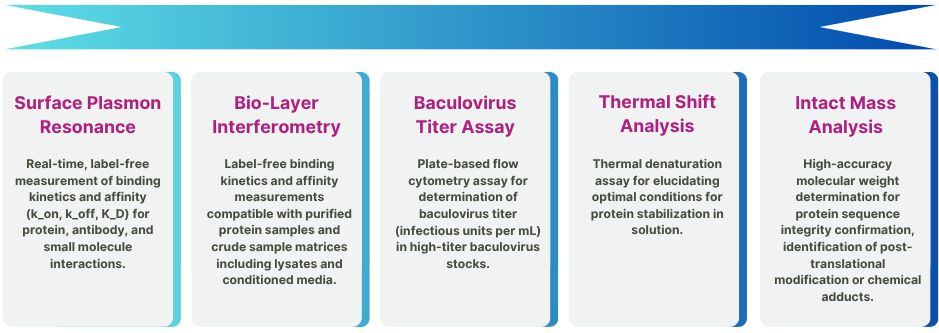


Our available assay services include surface plasmon resonance (SPR), bio-layer interferometry (BLI), baculovirus titer assay, thermal shift assay (TSA), intact mass analysis, and commercially available colorimetric and fluorometric assays. These services can be used for stand-alone analysis or integrated into a customized gene-to-protein workflow to meet your specific needs.
Surface plasmon resonance (SPR) is a gold-standard, label-free optical technique for measuring real-time biomolecular interactions. By detecting changes in the refractive index at a sensor surface, SPR provides precise kinetic and affinity data for protein-protein, protein-small molecule, protein-antibody, and other binding pairs.
Bio-layer interferometry (BLI) is a label-free, fiber optic biosensor technology that measures biomolecular interactions in real time by analyzing interference patterns of white light reflected from two surfaces: a layer of immobilized protein on the biosensor tip and an internal reference layer. Shifts in the interference pattern correspond directly to changes in the number of molecules bound to the tip.
We utilize a plate-based flow cytometry assay for rapid, reproducible titer determination (infectious particles per mL) of baculovirus stocks, enabling infection of insect cells using a calculated MOI (multiplicity of infection). Understanding MOI is an important step in consistent production of recombinant proteins using baculovirus mediated expression platforms.
Thermal shift assay (TSA), also known as Differential Scanning Fluorimetry (DSF), is widely used in structural biology and drug discovery to study the thermal stability and binding properties of proteins, aiding in the characterization and optimization of protein-based research.
Mass spectrometry is a powerful tool for protein characterization. Our intact mass analysis service offers high-accuracy molecular weight determination for confirming the integrity of protein sequences and the identification of post-translational modifications or chemical adducts.
We utilize the Waters BioAccord LC-MS, an electrospray ionization-time of flight (ESI-TOF) mass spectrometer for intact mass determination of proteins and antibodies. The instrument is self-optimizing to ensure consistent, high-quality data.
The thermal shift assay relies on the principle that as proteins undergo thermal denaturation, their hydrophobic regions become exposed. These exposed regions can then interact with hydrophobic dyes or fluorescent probes. By tracking changes in fluorescence intensity, the protein’s melting temperature (Tm), an indicator of its stability, can be determined.
MOI (multiplicity of infection) measures the number of infectious virus particles used for infection relative to the number of insect cells in the culture. Infections based on MOI, rather than volume to volume, result in greater consistency between pilot and production scale expression and batch-to-batch production because the titer of a baculovirus stock will decrease over time.